


Occupancy across manufactured housing remains strong. Demand for affordable housing continues to outpace supply. At the same time, operating costs are climbing, regulatory scrutiny is tightening, and resident expectations for digital communication and online payments are rising.
That combination creates pressure.
Manufactured housing isn’t generic multifamily or apartments. It’s operationally layered:
- Utility billing and submetering compliance
- Rate recertifications and recovery tracking
- Titling and inventory management
- Long-term resident relationships
- Community-level rules enforcement
- Electronic payment processing and collections discipline
Each layer carries financial and compliance implications. Miss one detail like an outdated utility rate, a missed delinquency follow-up, an improperly documented violation, and it hits NOI negatively.
Now add AI to the conversation.
AI is everywhere right now. Vendors are rebranding dashboards, chat tools, and basic automations as “AI-powered.” But not all AI belongs in manufactured housing. In fact, applied incorrectly, it can create more noise than value.
The real question isn’t:
“Should we use AI?”
It’s:
“Where does AI in manufactured housing actually improve operations without introducing risk, inconsistency, or compliance exposure?”
That’s what this article is designed to clarify.
AI should not replace operators. Manufactured housing is relationship-driven, regulation-sensitive, and operationally nuanced. Judgment, oversight, and market experience still matter.
Where AI fits is unique in this industry.
It belongs where it reinforces operational discipline.
Where it enforces consistency across communities.
Where it improves response speed without sacrificing control.
Where it supports scale without requiring proportional headcount growth.
If applied correctly, AI becomes an operational layer inside your property management software—not a gimmick, not a bolt-on tool, but a structured workforce multiplier embedded into leasing, sales, collections, communication, and compliance workflows.
For experienced operators, that distinction matters.
First, Let’s Define the Goal: Operational Scale Without Operational Strain
Before we talk about AI, let’s get clear on the outcome.
Manufactured housing operators aren’t chasing shiny tech. They’re trying to scale intelligently in a business that’s operationally dense—utilities, compliance, resident screening, electronic payments, violations, maintenance, reporting. Every workflow touches revenue or risk.
The real goal?
Grow while improving your operating model.
Most operators want to:
- Expand portfolios without adding proportional headcount
- Protect NOI through tighter collections and utility recovery
- Improve response times across leasing and resident communication
- Maintain compliance discipline across every community
- Deliver a consistent resident experience at scale
- Sell or rent inventory quickly and efficiently
That’s the standard. Anything less starts to erode margin.
Where AI Actually Fits
AI fits where it strengthens execution. It works best when it:
- Reduces repetitive workload (follow-ups, reminders, documentation)
- Improves response speed (leasing inquiries, delinquency outreach, payment confirmations)
- Enforces consistency (violations, collections workflows, communication templates)
- Supports decision-making with structured, real-time operational data
- Protects margins by preventing missed steps and delayed actions
- Eliminates redundancies (answering basic rent questions, booking appointments)
In other words, AI should function as an operational layer inside your property management software handling the predictable, process-driven work that slows teams down.
Where AI Does Not Belong
Let’s be clear.
AI does not fit where it:
- Removes human oversight from compliance-sensitive decisions
- Introduces risk into utility billing, rate updates, or regulatory documentation
- Overcomplicates simple workflows with unnecessary automation
- Replaces sensitive conversations with residents
Manufactured housing is long-term housing. Relationships matter. Judgment matters. Market context matters.
AI should support that foundation—not override it.
When applied correctly, AI doesn’t change your operating philosophy. It reinforces it. It tightens discipline, reduces friction, and gives your team more bandwidth to focus on growth, retention, and strategic decisions.
Where AI Fits: High-Volume, Process-Driven Workflows
If you’ve been operating in manufactured housing for more than a few years, you already know where the bottlenecks live.
It’s not strategy. It’s execution.
The daily, repeatable, process-driven work that stacks up across communities and quietly eats into margin.
AI fits best in workflows that are:
- Repetitive
- Rules-based
- Time-sensitive
- Often delayed due to bandwidth
That’s where operational drag happens. And that’s where intelligent automation can actually move the needle.
Let’s break it down.
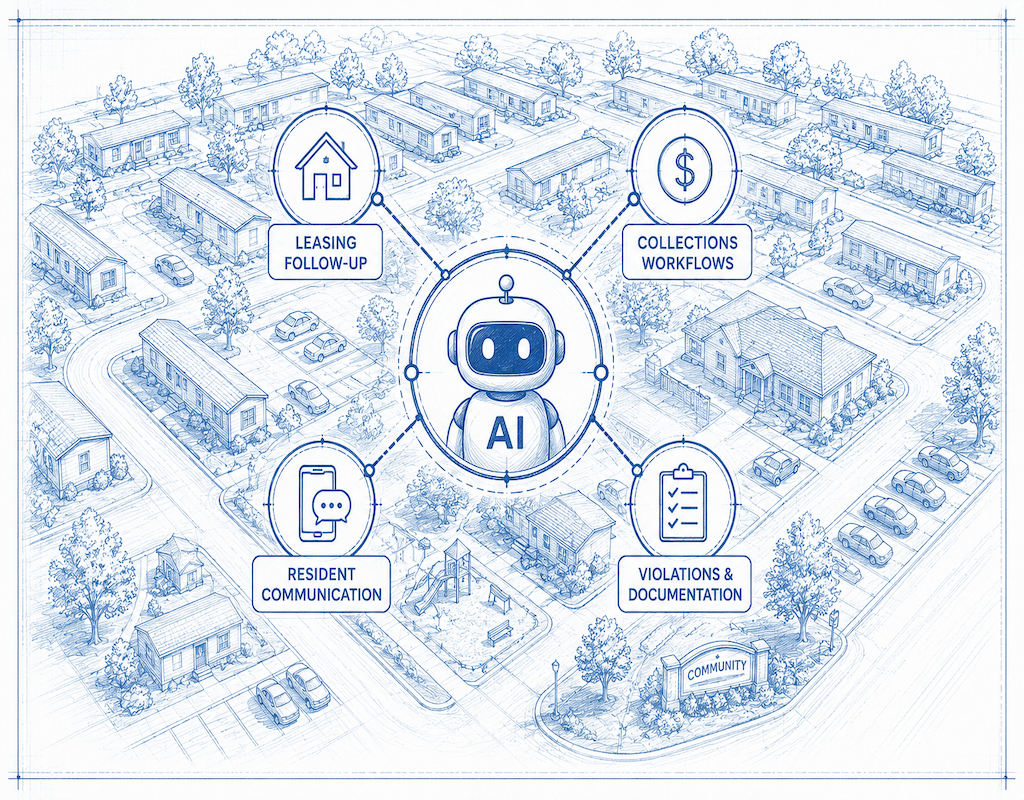
Leasing & Prospect Follow-Up
Speed matters. The first community to respond often wins the lease.
AI can:
- Deliver instant responses to inbound inquiries
- Trigger automated qualification workflows
- Ensure consistent follow-up without manual tracking
No more leads sitting in an inbox because the onsite team is handling inspections or utility disputes. AI handles the first layer. Your team steps in where judgment is required.
Collections & Delinquency Management
Consistent rent follow-up protects NOI. Missed reminders and delayed outreach quietly erode it.
AI works well here because the process is structured:
- Automated reminders before and after due dates
- Predefined escalation paths based on delinquency timelines
- Payment coordination workflows tied to electronic payment solutions
- Intelligent initial conversations around past due rent
The key is consistency. Every resident receives the same structured communication, every time. That reduces leakage without adding pressure to your onsite staff.
Violations & Compliance Tracking
In manufactured housing, documentation matters. A lot.
AI supports:
- Consistent documentation of violations
- Automated notice generation tied to rules
- Standardized enforcement workflows across communities
You maintain oversight. The system maintains discipline. That’s how you scale without creating compliance gaps.
Resident Communication
Residents expect fast answers. Not next-week callbacks.
AI can provide:
- 24/7 response capability for common inquiries
- Multilingual support across diverse communities
- Workflow-triggered updates tied to maintenance, payments, or violations
It’s not replacing conversations. It’s covering the predictable questions so your team can focus on relationship-driven interactions.
This is where AI becomes practical.
Through our AI workforce automation capabilities, ManageAmerica customers can deploy AI-powered workers directly inside the platform to handle high-volume workflows — from leasing and collections to violations and resident communications — while maintaining operator oversight.
No replacement of expertise, just structured execution at scale.
Where AI Doesn’t Fit in Manufactured Housing (And Why That Matters)
Manufactured housing is regulated, documentation-heavy, and relationship-driven. That’s exactly why you can’t blindly automate everything... at least not today.
AI has a role. But it’s not the decision-maker.
Here’s where it does NOT belong:
1. Complex Compliance Judgments
Utility billing regulations. Submetering disclosures. Rate recertifications. Fair housing considerations. Titling documentation.
These are not areas for autonomous decision-making.
AI can organize data and trigger reminders. It should not interpret regulatory nuance or make judgment calls on compliance-sensitive situations.
That responsibility stays with operators.
2. Strategic Asset Management Decisions
AI can surface trends. It can highlight delinquency patterns, occupancy shifts, or maintenance backlogs.
It can assist with but should not decide:
- When to raise rents
- How to structure payment plans
- Whether to reposition a community
- When to refinance or expand
Those decisions require market context, capital strategy, and experience.
AI informs. Operators decide.
3. Overriding Operator Review Processes
In manufactured housing, documentation matters. Especially with violations, collections, and resident disputes.
AI can:
- Draft notices
- Organize communication
- Trigger workflow steps
But final approvals, overrides, and exceptions need human review.
Automation without oversight is how risk creeps in.
4. Operating Outside a System of Record
AI tools that sit outside your core property management software create fragmentation.
Data gets duplicated. Notes get lost. Reporting becomes inconsistent.
In manufactured housing operations, everything ties back to:
- Resident accounts
- Utility recovery
- Lease documentation
- Payment history
- Compliance records
If AI isn’t embedded within a structured system of record, it adds complexity instead of reducing it.
AI should strengthen your operating model, not destabilize it. It should enhance your property management software, not bypass it.
Manufactured housing is too nuanced, and too margin-sensitive, for shortcuts.
Used correctly, AI reinforces operational discipline and strengthens execution.
Used carelessly, it can introduce unnecessary risk and distraction.
Experienced operators know the difference.
Why Manufactured Housing Requires AI Built Specifically for Its Operations
Manufactured housing isn’t simplified multifamily. It’s operationally layered, compliance-sensitive, and margin-driven. That matters when we talk about AI in property management software.
If the technology doesn’t understand how this asset class works, it won’t deliver real value.
Manufactured housing operations include:
- Utility billing complexity: submetering, rate changes, RUBS calculations, regulatory disclosures
- Recapture and recovery tracking: ensuring every billable dollar is accounted for and defensible
- Titling and inventory management: MCOs, ownership transfers, lien releases
- Long-term resident lifecycle management: screening, onboarding, payment history, renewals, community compliance
- Regulatory nuance: state-specific rules, documentation standards, audit readiness
These aren’t edge cases. They’re daily realities.
Generic AI tools trained on traditional multifamily data don’t understand this operational depth. They don’t account for utility recovery nuances. They don’t factor in titling workflows. They don’t recognize how violations, collections, and compliance intersect at the community level.
And that’s where operators run into problems.
AI that isn’t purpose-built often:
- Misses workflow dependencies
- Creates reporting gaps
- Operates outside compliance safeguards
- Adds friction instead of reducing it
Innovation in manufactured housing must be purpose-built, not retrofitted.
That means:
- Embedded within a modern web-based property management platform
- Structured around manufactured housing workflows
- Designed to operate inside a centralized system of record
- Backed by real industry expertise
Modern architecture matters here. AI can only execute effectively when it’s layered inside software built specifically for manufactured housing operations—not bolted onto legacy systems that were never designed for this level of automation.
For operators who plan to scale, that distinction isn’t technical. It’s strategic.
The right AI strengthens execution across utilities, collections, resident screening, compliance, and electronic payment workflows.
From Software That Records Activity to Software That Executes Work
Let’s be honest about where most property management systems still sit.
They record activity.
They log payments.
They store leases.
They track notes.
They generate reports.
That worked when portfolios were smaller and onsite teams had more time to manually follow up on everything.
But scale exposes friction.
Legacy systems typically:
- Store information but don’t act on it
- Require manual follow-up for leasing, collections, and violations
- Depend heavily on human tracking and reminders
- Create operational gaps between “knowing” and “doing”
In manufactured housing, that gap costs money. Missed rent reminders delay cash flow. Slow prospect response times reduce conversions. Inconsistent enforcement increases risk.
Modern property management platforms operate differently.
They:
- Execute workflows, not just log them
- Enforce consistency across communities
- Integrate automation layers directly into operations
- Scale operational output without scaling headcount
That’s the shift.
The next generation of manufactured housing software doesn’t just document operations — it supports and accelerates them.
It moves from being a passive system of record to an active operational engine.
For experienced operators, that’s not a tech upgrade. It’s an efficiency upgrade.
What This Means for Operators in 2026 and Beyond
The next 12–24 months won’t reward operators who simply “add more staff” to keep up.
Margins are tighter. Labor is expensive. Regulatory oversight isn’t slowing down. Residents expect digital payments, faster responses, and structured communication.
The operators who win will be the ones who scale intelligently.
Those who implement AI responsibly will:
- Scale portfolios without scaling stress
- Reduce operational drag across leasing, collections, and compliance
- Improve NOI through consistency and timely follow-up
- Deliver faster, more structured communication to residents
- Create a modern resident experience that aligns with today’s expectations
Not by replacing teams — but by reinforcing them.
On the other side, operators who ignore operational automation will likely:
- Add headcount to solve workflow inefficiencies
- Increase overhead as portfolios grow
- Rely on manual tracking and follow-up
- Experience inconsistency across communities
That gap compounds over time.
In manufactured housing, consistency drives performance. AI simply strengthens that consistency at scale.
Conclusion: AI Fits Where Operations Demand Precision
Manufactured housing is operationally complex. It always has been.
That complexity demands:
- Modern web-based architecture
- Purpose-built property management software
- Intelligent automation aligned with real workflows
AI fits into manufactured housing operations where it protects margin, enforces consistency, and enables growth — without replacing the expertise that makes great operators successful.
That’s the balance.
Disciplined execution supported by intelligent automation.
If you’re evaluating how to modernize your platform for your next phase of growth, now is the time to see it in action. Schedule a demo with one of our experts to see how ManagAmerica’s new AI capabilities can enhance your operations.


